How Sequoia Riverlands turned five spreadsheets into one automated cost calculator

In this article
Phil Daubenspeck is the Chief Investments and Partnerships Officer at Sequoia Riverlands Trust. He's a Rippling power user who uses the product to tackle hard business problems.
At Sequoia Riverlands Trust, we do a lot of billing out to our funders or people that we're providing services to. To bill accurately, we need a fully loaded pay rate for each employee — one that includes not just their salary, but taxes, benefits, insurance, overhead, training, time off, and more.
The problem: Scattered data across multiple spreadsheets
Every time we wanted to look at our true employee costs or project out billing rates, our team had to pull data from multiple spreadsheets and do the calculations manually.
It wasn't that we didn't have the data. We did. But stitching it together every time was incredibly time-consuming. And because the information was scattered, it was easy for things to get out of sync.
We needed a way to centralize all of that information so it would be easily accessible and automatically updated when things changed.
The solution: An employee cost calculator app
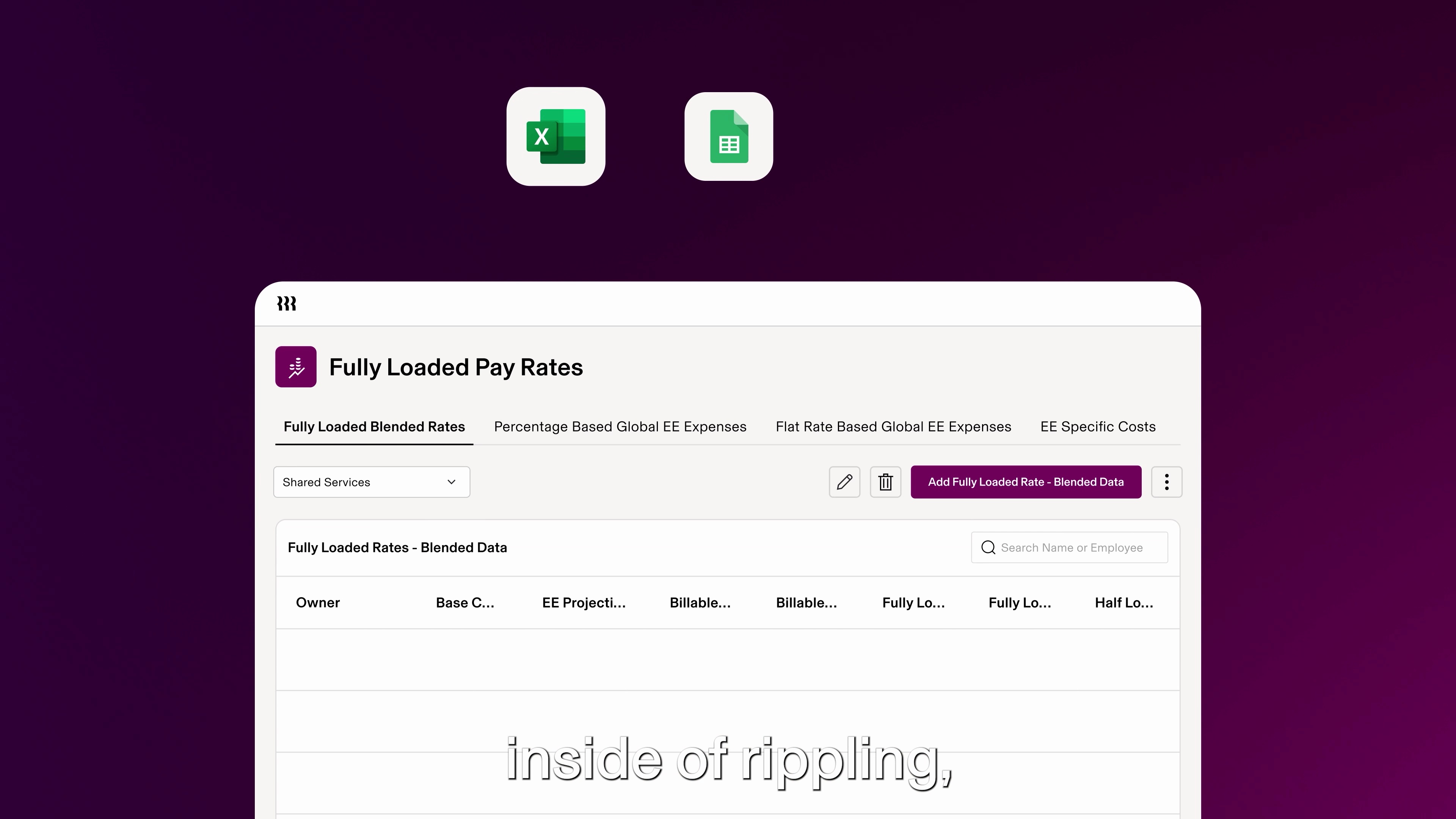
Working with Rippling's Forward-Deployed Engineering team, we built an app that gave us the centralization we needed. Here's how we built it.
Step 1: Map out the data we need
Before meeting with the team, I had spent some time mapping out the information we'd need. When I got there, we sat down and figured out specifically where those pieces were going to land in the app. Within 20 to 30 minutes, we started building.
Step 2: Organize the data structure
Part of the challenge was figuring out how to store and organize the data so it would be easily accessible. Making it easy to update was really important to us. We talked through different approaches — if we do it this way, here are some limitations; if we do it that way, here are others.
Some of those limitations I knew about. Some I didn't. Being able to ask questions like "What if a number needs to become a currency?" or "How do we make this field work?" was really helpful.
The Rippling team was extremely knowledgeable, very friendly, and very curious about our business and the work we're doing on the ground. They were guiding the conversation and not trying to catch up with me, which was great.
Step 3: Build the app to pull and display costs
The app now holds all our data inside Rippling. For every employee, it pulls their base salary, taxes, benefits, time off, insurance, overhead (like real estate and business software expenses per spread per employee), training, and all the other costs that go into their true employment cost.
By combining internal Rippling data with external overhead data, the app calculates a complete picture of what each employee costs us — individually and with a fully loaded pay rate. And because so much of the data already lives in Rippling, it auto-updates without us having to manage multiple spreadsheets.
The impact
This app has completely changed how our finance and billing teams work.
Instant access to billing rates
We can now pull information virtually instantly whenever we have a question about costs. Before, our team had to pull data together and do the calculations every single time.
Better cost recovery and planning
Our app allows us to project out what billing rates will be in the future. We have a much better idea of what it costs us to operate our departments and what it costs us to employ specific people. This will help us recover more funds that are spent on the projects we're working on.
Time savings and better morale
This will make a pretty incredible impact on the time it takes for us to bill our clients. And spending less time in spreadsheets? That's for sure going to help morale around the office.
Disclaimer
Rippling and its affiliates do not provide tax, accounting or legal advice. This material has been prepared for informational purposes only, and is not intended to provide or be relied on for tax, accounting or legal advice. You should consult your own tax, accounting and legal advisors before engaging in any related activities or transactions.

Author
Phil Daubenspeck
Chief Investments and Partnerships Officer
Hubs
Explore more

How Athena automated license tracking for 250+ clinicians
See how Athena managed license tracking for 250+ clinicians, eliminating manual spreadsheets and ensuring compliance with automated renewal reminders.

Migrating from Spreadsheets to an HRIS: Less Painful Than You Think
Most SMEs assume migrating from spreadsheets to a modern HR system will take months of pain. It won't. For a small or mid-sized business, a well-scoped HRIS implementation typically takes between two and eight weeks — and the platform does most of the heavy lifting. This guide walks through five practical steps to get your people data moved over cleanly, your compliance set up correctly, and your team actually using the new system.

Finance Teams Don’t Hate Spreadsheets. They Hate Babysitting Them.
Finance teams rely on spreadsheets for modelling and forecasting, but too much time is still lost to manual reconciliation, disconnected HR systems and shadow data tracking. As organisations grow, outdated processes create operational risk, compliance headaches and costly inefficiencies that pull finance away from high-value strategic work.

The Spreadsheet That's Running Your HR (And the Risk You're Probably Not Seeing)
Employee data breaches in the UK hit a six-year high in 2024 — and human error was a factor in 70% of them. For SMEs still managing HR through spreadsheets, shared drives, and email threads, the risks are real and growing. This post breaks down what spreadsheet-based HR is quietly costing your business in time, compliance exposure, and strategic capacity — and why the Employment Rights Act 2025 makes it a problem you can no longer defer.

Nike, H&M and Uber Lost Millions to Payroll Compliance Failures. Don't Be Next.
Compliance failures don’t just happen to small companies—Nike, H&M, and Uber have all paid the price. This article explores how hidden risks in payroll, worker classification, and people data can quietly build across disconnected systems, and why treating compliance as a core part of your infrastructure is key to avoiding costly mistakes.

How our European team uses Rippling IT
Manual IT provisioning means crossed wires, missed access, and a first day that starts with troubleshooting instead of onboarding. This post breaks down how Rippling handles provisioning differently — from contract signature to day one setup, role-based access that updates automatically, and compliance logs that are always audit-ready.

Beyond Borders: Expanding Across EMEA and Beyond
International expansion across EMEA presents significant compliance, payroll and operational challenges. This blog explores how modern businesses are replacing slow entity-first expansion models with unified workforce infrastructure, enabling faster hiring, automated compliance, consolidated payroll and seamless scaling into new markets without unnecessary risk or complexity.

The Great Offboarding: The Dutch compliance gaps hiding in plain sight
Hybrid work, contractor access and fragmented systems are creating major offboarding risks for Dutch businesses. As organisations navigate GDPR (AVG), works council oversight and growing SaaS sprawl, many are discovering that outdated manual offboarding processes leave dangerous compliance and security gaps behind long after employees or contractors leave.
See Rippling in action
Increase savings, automate busywork and make better decisions by managing HR, IT and Finance in one place.