Source: Rippling
The Best Global Payroll Software for Australian Businesses
In this article
If your business has an HR team, you know that payroll is a big administrative challenge for them. Indeed, according to our latest State of HR report, 36% of HR professionals rank payroll processing and management as their most time-consuming HR admin task. For businesses expanding internationally, that administrative burden can multiply as teams add new tax systems, currencies, employment rules, and reporting obligations.
Your team has to manage more than local obligations, such as PAYG withholding, superannuation contributions, STP Phase 2, and Fair Work requirements. They have to navigate the tax systems, employment laws, and reporting necessities in every country where you have employees.
And payroll is one of the biggest sources of international compliance risk. In the latest State of Global Hiring report, 35% of those surveyed said that payroll and tax compliance with local laws is the HR responsibility that causes the most compliance issues.
The right global payroll platform can make a big difference. By connecting payroll, compliance, and workforce data in one place, modern software platforms can reduce manual handling, improve visibility across borders, and provide a better, more consistent employee experience.
Not all global payroll solutions work in the same way, though. Some run payroll through their own technology and local payroll infrastructure, while others consolidate data from local payroll providers or deliver payroll as a managed service. Some global employment platforms also offer payroll as part of an employer of record (EOR) service, allowing businesses to hire employees in countries where they don't have their own legal entity.
That's why it's important to compare providers based on the model they use, as well as their country coverage, payroll capabilities, compliance support, payment infrastructure, integrations, and level of control.
To help you find the right solution for your business, we've taken an in-depth look at 14 of the leading global payroll software providers that are available to Australian businesses, comparing them across six factors:
Global payroll coverage and execution
Compliance and tax risk management
Payments and forward exchange handling
Platform architecture and automation
Operating model transparency
Commercial scalability
The Best Global Payroll Services for Australian Businesses at a Glance
Rank | Platform | Best for | Choose this if |
|---|---|---|---|
1 | Rippling | Mid-market to enterprise businesses | You want a platform that unifies payroll data and workflows with finance, IT, and HR |
2 | ADP Global Payroll | Enterprise compliance and risk control | Regulatory certainty and mature governance matter most |
3 | CloudPay | Enterprise managed payroll partnership | You prefer a managed delivery model with central oversight |
4 | Remote Payroll | Scalable structured coverage | You want broad country support within a vendor-managed model |
5 | Papaya Global | Enterprise-friendly coverage | You operate across multiple regions and want structured consolidation |
6 | Ramco Systems | Enterprise payroll architecture | System-of-record integrity and multi-entity governance are priorities |
7 | Multiplier | Rapid international expansion | You need broad coverage with developing operational maturity |
8 | G-P (formerly Globalization Partners) | Managed global infrastructure | You prefer a service-led global payroll framework |
9 | Pebl (formerly Velocity Global) | Structured expansion oversight | Governance and cross-border compliance reassurance matter |
10 | Oyster HR | Simpler global payroll needs | You manage smaller distributed teams |
11 | Epi-use Labs | SAP-aligned environments | You prioritise integration within enterprise ERP systems |
12 | Skuad | Entry-level international payroll | You need access across jurisdictions with lighter complexity |
13 | Employment Hero | AU-centric teams expanding globally | You want local payroll familiarity with limited global depth |
14 | Lano | Coordination-layer models | You prefer aggregating country partners rather than a unified platform |
For the full ranking methodology, review the full spreadsheet of ratings.
Comparing the 14 best global payroll platforms for Australian businesses
We analysed 14 leading global payroll software providers available to your business, looking at their strengths, limitations, and ideal use cases.
Rippling
ADP Global Payroll
CloudPay
Remote Payroll
Papaya Global
Ramco Systems
Multiplier
G-P (formerly Globalization Partners)
Pebl (formerly Velocity Global)
Oyster HR
Epi-use Labs
Skuad
Employment Hero
Lano
1. Rippling
Rippling takes a different approach from many other payroll software providers. Its primary differentiator is the fact that it’s built on a unified data model.
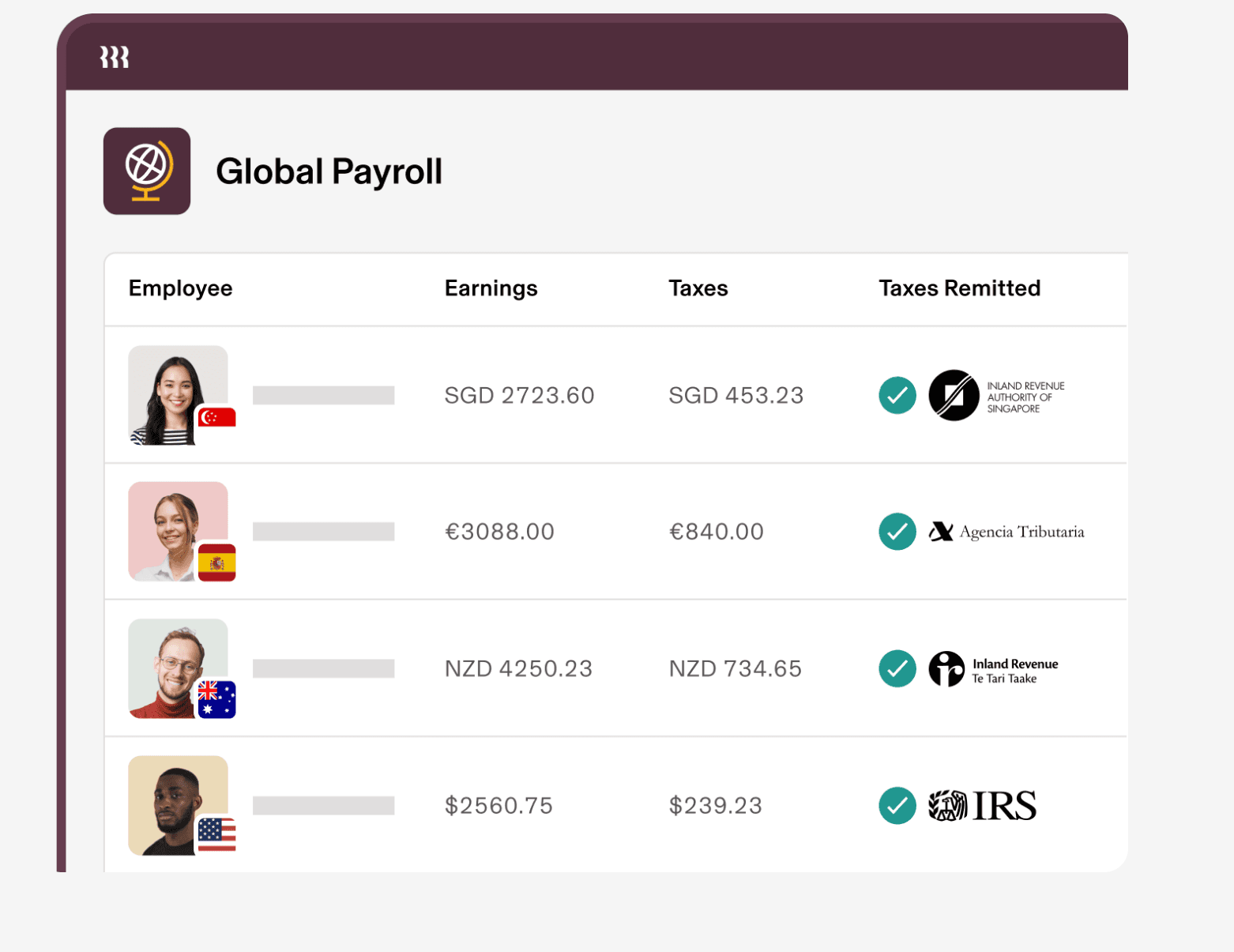
That means Rippling's unified platform connects HR, payroll, IT and finance data around a shared employee record, creating a single source of truth for workforce operations. When employee information changes, Rippling can automatically trigger the relevant workflows across connected systems, reducing the need for duplicate data entry and manual handoffs.
Source: Rippling
Rippling also helps businesses manage statutory payroll processes, regulatory requirements, security controls, and workforce documentation in the same platform. Across FX handling, PAYG, superannuation, and international hiring obligations, this unified approach can reduce manual administration, improve accuracy, and give HR and finance teams greater control over their payroll operations and more time back in their working day.
This can mean a significant reduction in admin time for your HR team. Research from Benenson Strategy Group reveals that Rippling customers with 2–1,000 employees can process payroll in 5–30 minutes, which is 18–110x faster than the average company.
When hospitality company Liven was struggling to ensure payroll compliance, timeliness, and accuracy across operations in the US, Australia, and Southeast Asia, it turned to Rippling. That move reduced the company’s payroll effort from three FTEs to just 0.5 FTE.
Rippling AI adds an intelligence layer to this connected data. HR and finance teams can use natural-language prompts to analyse payroll and workforce trends, generate reports, identify anomalies, and answer questions without manually pulling information from multiple systems. It can also carry out certain payroll and HR tasks, such as adding one-off bonuses, with human approval before changes are made.
Why companies choose Rippling
Unified financial architecture: With Rippling, there is no more legacy middleware; HR, payroll, and spend management live in one native environment.
Seamless compliance workflows: Rippling applies supported Australian payroll rules, including modern award rates, overtime, penalty rates, and allowances, while automating payroll and tax workflows.
Automated global onboarding: Rippling can connect HR, payroll, IT, and workforce workflows so that onboarding tasks can be triggered automatically rather than handled through separate systems.
“Rippling has improved how different teams manage access, payroll, and HR functions. Its integrated platform simplifies even the most complex workflows, enabling seamless oversight of employee lifecycle processes from onboarding to offboarding.” Rippling Capterra review
Things to consider
Increased pricing with added features: The modular platform means that the price can increase rapidly as you add the features you need.
Configuration intensity: The sheer depth of the automation calls for a structured implementation phase; this isn't a simple plug-and-play tool.
2. ADP Global Payroll
ADP Global Payroll is the safe bet for enterprise-based corporations where regulatory certainty and audit-readiness outweigh the need for a modern user interface. It’s built for high-risk payroll and compliance at scale.
ADP combines its own global payroll technology and services with a network of in-country payroll partners, giving customers access to local payroll expertise across 140+ countries and territories. For an Australian CFO, this means ‘boots on the ground’ expertise that reduces potential middleman risk.
The trade-off is that ADP's enterprise-focused approach may be more than smaller organisations need, particularly where they prioritise a lightweight, self-service experience.
Why companies choose ADP
Institutional authority: ADP has decades of experience managing deep statutory alignment in nearly every market on earth.
Direct tax remittance: They don't just calculate tax; they pay it to the local authorities on your behalf, reducing your risk.
Global infrastructure: It offers a massive delivery network that handles complex currency moves and FX orchestration without the "growing pains" of a startup.
“I´ve used ADP Global view as part of my General Motors user software. It´s a great app to track pay and time-related information.” ADP Global Capterra review
Things to consider
Platform rigidity: The interface feels like legacy software and is significantly less configurable than its modern peers.
Bureaucratic support: Getting a fast response for a small edge case can be challenging.
3. CloudPay
CloudPay is the specialist choice for mid-to-large enterprises that require a managed service model with high-control financial oversight. It bridges the divide between traditional outsourcing and modern digital reporting.
CloudPay offers a highly mature delivery model focused on enterprise-grade payroll and payments. Its sophisticated capabilities in FX and multi-currency management are especially relevant for Australian firms with complex worldwide funding needs.
With CloudPay, you trade the self-service speed of an EOR (employer of record) for a high-control managed environment that prioritises Gross-to-Net accuracy and audit readiness.
Why companies choose CloudPay
Global payroll and payments: Payroll and payment services across 130+ countries and 168 currencies.
Managed service model: Combines payroll technology with specialist payroll services.
Global reporting: Provides centralised visibility into multi-country payroll data.
"Nice platform for payroll management" G2 CloudPay review
Things to consider
Managed-service delays: Managed-service models may offer less day-to-day self-service than software-first platforms.
Opaque implementation costs: Businesses should clarify implementation scope, fees, and responsibilities during procurement.
4. Remote
Remote is best known for its global employment and EOR offering, but it also provides a global payroll service in a defined set of countries. This makes it particularly relevant to Australian businesses that want to combine payroll capabilities with international hiring and EOR services, although buyers should check that the specific countries in their workforce footprint are supported by global payroll rather than EOR.
Remote focuses on the human side of the global payroll equation. While many multicountry payroll software tools treat pay as a transactional event, Remote provides the localised benefits and total rewards visibility that helps move the needle for elite hires. For a finance team, it offers a standardised pricing structure and a reliable global payout network, but it depends on a mix of owned entities and third-party partners.
With Remote, you trade absolute direct operational control for a premium, low-friction onboarding experience.
Why companies choose Remote
Predictable global scaling: Country expansion follows a structured pricing model with minimal renegotiation required.
Enterprise-grade security: Remote maintains strong security certifications and formal privacy governance across all jurisdictions.
Structured funding workflows: The solution provides centralised funding processes with organised disbursement orchestration to ensure payment reliability.
"We have moved all our 3rd party team members over to Remote from other providers. Remotes portal is super easy to use, requires literally no training." Remote Capterra review
Things to consider
Partner-led execution: Because execution control varies by region, some backend layers are less transparent than a fully native engine.
Integration depth: While it integrates with leading HR systems, the breadth of automation isn’t as extensive as that of ecosystem-leading platforms.
5. Papaya Global
Papaya Global is a sophisticated data-first platform built for enterprises that need to unify disparate payroll streams into a single reporting layer. It’s ideal for Australian firms that prioritise financial visibility and advanced business intelligence (BI) over basic administrative outsourcing.
Papaya Global acts as a high-level digital layer over a global network of local providers. Unlike platforms that force a total migration to their own engine, Papaya is built to consolidate data from various gross-to-net (G2N) mapping sources and human resources information systems (HRIS). For a Finance Director, this means gaining a ‘single pane of glass’ view without the operational trauma of a complete system revamp.
Because Papaya uses a preferred-partner model in many markets, businesses should confirm how payroll is delivered in each country and what level of local operational visibility they’ll receive.
Why companies choose Papaya Global
Advanced reporting and visibility: Their platform provides a centralised visibility layer that excels at consolidating data across many countries.
Strong FX support: Papaya Global provides structured multi-currency payroll funding with centralised coordination across its partner network.
Flexible hybrid model: The solution supports a variety of service models, allowing companies to maintain existing local relationships while centralising governance.
"They combine a strong platform with exceptional service, allowing management teams to stay focused on the business while knowing payroll, compliance, and global employment complexities are handled properly." Papaya Global Capterra review
Things to consider
Workflow transparency gaps: Because execution is often partner-led, there can be lags in real-time status updates within the platform.
Commercial ambiguity: The tiered pricing framework is structured, but the involvement of partner layers can sometimes introduce bundled cost components.
6. Ramco Systems
Ramco Systems is a high-control architectural solution designed for large-scale organisations that prioritise a unified system-of-record over modern user interface design. It’s built for complex, multi-entity environments that require deep integration with existing enterprise resource planning (ERP) frameworks.
Ramco offers a high-control delivery model. For an Australian finance lead, this provides a level of treasury security and direct statutory alignment, helping decrease the risks associated with third-party aggregators.
Ramco now markets Payce as a global payroll platform covering 150+ countries, combining its own payroll technology with regional delivery teams and in-country partnerships. With Ramco, you trade a contemporary user experience (UX) for a strong, centralised architecture that excels at automated gross-to-net pay calculations and complex workflow orchestration.
Why companies choose Ramco Systems
Architectural integrity: The solution features a structurally centralised payroll architecture that ensures data consistency throughout all international jurisdictions.
Enterprise-grade finance integration: It provides connectivity with major ERP systems, enabling automated financial handoffs and journal entries.
Advanced multi-entity governance: Provides strong centralised control and reporting for organisations managing a high volume of global legal entities.
"Easy, inexpensive, accurate, reliable. Good for small, medium, and large organizations." Ramco Capterra review
Things to consider
Compliance accountability gaps: Unlike full-shield providers, it uses a shared accountability model and offers only basic guidance on worker classification risks.
Implementation overhead: The depth of the system-of-record design yields an ordered yet often complex implementation timeframe.
7. Multiplier
Multiplier is a specialised compliance engine designed for firms scaling into high-risk jurisdictions where local legal shielding is the primary priority. It intentionally trades broad feature sets for deep, localised employment contract security and direct entity custody.
Multiplier uses a combination of its own entities and local partners, depending on the market. Businesses should therefore confirm the delivery model and level of local accountability in each country they plan to enter. While it’s not a full-suite HRIS, it excels at managing international payroll, with a focus on statutory tax filing and localised benefits.
With Multiplier, you trade all-in-one platform depth for highly structured risk mitigation and commercial transparency.
Why companies choose Multiplier
Direct entity control: By employing workers through its own local legal entities, Multiplier avoids the issues associated with third-party partners.
Localised benefit stacks: It simplifies the provision of competitive, statutory-aligned insurance, superannuation, and other benefits for remote talent.
Structured risk mitigation: It assumes structured accountability for compliance, specifically protecting the business against worker misclassification.
"Multiplier is the best partner to set up distributed teams in Asia." Multiplier Capterra review
Things to consider
Functional interface: The dashboard is reliable but utilitarian, and it lacks the advanced automation and slick UX of its more contemporary venture-backed competitors.
Limited reporting depth: It offers basic capabilities in reporting and data exporting, which may frustrate finance teams requiring granular business intelligence.
8. G-P (formerly Globalization Partners
G-P is a premium, service-heavy EOR built for enterprises that value a managed model over self-service software. It’s a high-stability choice for firms that want to outsource the entirety of their global employment liability.
G-P focuses on mature delivery and strong local compliance coverage. For an Australian CFO, this platform functions as a formal layer of protection against FX volatility and changes in international regulations. While the platform's automation is less advanced than its SaaS-first rivals, its institutional-grade infrastructure ensures dependability in funding workflows and payment orchestration.
With Globalization Partners, you trade a higher premium and less operational control for a white-glove managed service and enterprise-grade security.
Why companies choose G-P
Mature compliance framework: G-P's EOR model means G-P becomes the legal employer in supported markets and handles employment administration, payroll, and local compliance responsibilities.
Global payment reliability: The solution features highly structured funding workflows and strong FX support to ensure traceability of international disbursements.
Enterprise security controls: It upholds strict data privacy and documentation controls suitable for public or highly regulated firms.
"GP meets our Requirements”. G-P Capterra review
Things to consider
Commercial rigidity: Pricing can be bundle-dependent and variable by country, leading to less predictability as a business grows rapidly.
Limited workflow transparency: As a managed model, it gives users restricted visibility into real-time payroll stages compared to self-run platforms.
9. Pebl (formerly Velocity Global)
Pebl is a high-governance EOR built for enterprises that prioritise regulatory certainty over low-cost entry. It’s a solid option for Australian firms that require deep statutory alignment and a proven track record in complex worldwide jurisdictions.
Pebl boasts more than a decade of compliance leadership and offers an AI-driven global work platform. For a finance director, the platform’s full-service filing and remittance and its ability to offer instant onboarding are sources of consistent value.
While its base pricing is often higher than SaaS-only rivals, the trade-off is high-control delivery. It also owns a vast majority of its local entities, which offers additional peace of mind.
Why companies choose Pebl
Proven statutory expertise: Access to over 200 in-house legal experts ensures that local labour laws and tax obligations are managed with institutional precision.
AI-driven efficiency: The new platform architecture allows for instant quotes and rapid onboarding, reducing the friction of international expansion.
Direct entity ownership: Pebl combines owned entities with local partners to provide coverage across 185+ countries.
"By using Pebl, I can ensure that we provide the highest standard of service to our new hires, while also maintaining compliance across multiple countries. The system is straightforward, and the customer service has been exceptional." Pebl G2 review
Things to consider
Premium pricing structure: As a high-governance provider, Pebl typically carries a higher total cost than leaner, tech-only alternatives.
Customisation friction: The platform’s shift toward standardised, AI-first workflows can sometimes create friction for organisations with highly bespoke internal HR processes.
10. Oyster
Oyster is a platform designed for the remote-forever era, with a heavy focus on the end-to-end employee experience. Oyster's global payroll service is currently available in a defined group of countries, including Australia, so businesses should check country-by-country availability rather than assume its broader EOR footprint applies to payroll.
Payment responsibilities can also vary by country. However, it’s a good option for Australian firms that prioritise worker retention and visibility into total rewards in competitive global markets.
Oyster leans into the human side of the global payroll equation. While many multi-country payroll software tools treat pay as a purely transactional event, Oyster provides the localised benefits and cultural fluency that move the needle for elite hires. For a finance team, it offers a standardised pricing structure and a reliable global payout network, though it relies more heavily on partner execution than its high-control rivals.
With Oyster, you trade direct operational custody for a premium, low-friction onboarding experience.
Why companies choose Oyster
Worker-centric interface: The dashboard is designed for employees, making it exceptionally easy for global teams to centrally manage their expenses and benefits.
Institutional knowledge base: Their Oyster Academy provides the deep regulatory and cultural insights required to hire in new territories without a full in-house HR team.
Standardised implementation: They offer a highly predictable onboarding process with clear, standardised pricing, making it easy to budget for rapid headcount growth.
"Oyster is very easy to use and is very clear in allowing us to set up employees that live elsewhere." Oyster G2 review
Things to consider
Partner-reliant execution: Reliance on local partners can lead to reactive compliance monitoring and variable support speed in niche markets.
Limited workflow transparency: Finance teams may find the limited status visibility frustrating when tracking specific payroll stages in real time.
11. EPI-USE Labs
EPI-USE is a highly specialised choice for large-scale Australian enterprises running SAP HR/payroll environments. It functions more as a technical integration layer than a standalone platform, prioritising data consistency for complex, multi-entity enterprises.
EPI-USE Labs features a hybrid-controlled delivery model focused on enterprise finance integration. For a finance lead, its ability to synchronise global payroll data directly with SAP SuccessFactors is where it delivers real value, reducing the manual burden of gross-to-net reconciliation. However, the platform relies on third-party partners for local filing in many jurisdictions, introducing an operational distance compared to native engines.
With EPI-USE Labs, you trade a modern UX and autonomous automation for deep architectural alignment with your existing ERP software.
Why companies choose EPI-USE Labs
Native SAP integration: EPI-USE Labs provides an enterprise-grade finance integration that ensures payroll data remains a direct extension of your core SAP environment.
Mature multi-entity support: It offers strong consolidated reporting and governance for organisations managing a high volume of global legal entities.
Managed service reliability: It provides a mature delivery model that’s well-suited for traditional enterprises that prefer vendor-led execution over self-service software.
“Friendly, helpful staff, efficient support and problem-solving. I can trust them as a partner to take care of the areas they are responsible for.” EPI-USE Labs G2 review
Things to consider
Fragmented cost structure: Pricing is often negotiated on a country-by-country basis, leading to a highly fragmented cost structure that is difficult to forecast.
Reactive enablement: Customer support and system updates can feel reactive rather than proactive, particularly when navigating rapid shifts in local labour laws.
12. Skuad
Skuad (now Payoneer Workforce Management) is a global workforce management provider designed for small-to-medium businesses entering emerging markets. It prioritises speed and standardised output.
Skuad is positioned as a developing delivery platform. While it provides a functional digital interface for managing international contractors and full-time staff, its partner-reliant calculations and low-control delivery model may raise concerns among sophisticated finance teams. For an Australian startup, it offers a low-barrier entry into new regions, but as headcount grows, the lack of deep API maturity and basic reporting may necessitate a more robust international payroll solution.
With Skuad, you trade long-term scalability and high-control visibility for immediate market access.
Why companies choose Skuad
Predictable commercial scaling: Skuad offers a mostly predictable pricing model with clear and standardised implementation costs for the most common use cases.
Broad functional coverage: It provides a reliable baseline for managing global payroll, benefits, and tax compliance across a variety of emerging jurisdictions.
Flexible scaling terms: It features standard enterprise flexibility in its contracts, allowing businesses to adjust their headcount without rigid multi-year locks.
"Hassle-Free Global Payroll with Payoneer: Automated, Reliable, and Responsive Support" Skuad by Payoneer G2 review
Things to consider
Limited operational transparency: The vendor-led execution model provides limited status visibility, making it difficult for finance teams to track payroll stages in real time.
Basic technical infrastructure: Its platform architecture and API access are basic, limiting its ability to integrate deeply with complex workforce automation stacks.
13. Employment Hero
Employment Hero is one of Australia's most established HR and payroll platforms, with its roots in Australian payroll and workforce management. It now also offers global employment through its HeroForce EOR service that covers 180+ countries. This makes it particularly relevant to Australian businesses that want strong domestic payroll capabilities alongside an EOR route for international expansion.
For Sydney-based firms, the dashboard's familiarity and strong finance integrations (such as Xero or MYOB) are significant pros. However, for true multi-country complexity, the low-control delivery and variable country pricing may not yet compete with SaaS-native global giants.
With Employment Hero, you trade global operational depth for local convenience and high automation within the Australian market.
Why companies choose Employment Hero
Seamless local integration: Employment Hero offers extensive native integrations with Australian accounting and workforce systems, ensuring a unified data flow for the home office.
Strong domestic automation: It features highly automated administrative controls and reporting that are purpose-built for the Australian Taxation Office (ATO) environment.
User-friendly implementation: The solution provides structured country-level implementation with strong documentation; HR teams without broad global experience will still find it easy to use.
"Simple and easy to use, one-stop shop for all your HR and payroll requirements." Employment Hero Capterra review
Things to consider
Architecture gaps: The partner-dependent global architecture can lead to inconsistencies in pay slip quality and localisation compared to its domestic performance.
Variable pricing structure: International costs are subject to a variable country pricing structure, making long-term budgeting for a distributed global team less predictable.
14. Lano
Lano is a global payroll consolidation platform designed for businesses managing payroll across multiple entities, countries, and local providers. Rather than replacing every local payroll system, Lano focuses on consolidating payroll data, automating data flows, and providing a centralised view of global payroll operations.
Lano is a developing delivery provider that currently uses a partner-reliant calculation model. For a finance lead, the platform offers a basic multi-country visibility layer, but it lacks the sophisticated gross-to-net (G2N) mapping and real-time workflow transparency found in top-tier rivals. It provides a standardised output for payslips and reports, but the low control architecture may present challenges for Australian firms scaling into highly regulated markets.
With Lano, you trade long-term architectural integrity for a low-barrier, federated architecture that’s easy to deploy but difficult to customise.
Why companies choose Lano
Flexible commercial terms: Lano features standard enterprise flexibility in its contracts, making it suitable for businesses that need to scale global headcount without rigid, multi-year lock-ins.
Cost-effective entry: It offers strong value for most simple use cases, particularly for firms that only need to manage a handful of international workers.
Streamlined implementation: The solution provides a basic implementation support framework that allows for relatively quick deployment compared to heavy-duty enterprise migrations.
"Lano: a user-friendly remote work solution" Lano Capterra review
Things to consider
Limited operational control: The vendor-led execution model means the client has limited direct control over payroll stages, leading to reactive support.
Basic technical extensibility: With basic API access and moderate automation, it may struggle to integrate seamlessly into a more mature, automated workforce tech stack.
Choosing the right global payroll software in Australia
Picking the right global payroll provider for your business is about much more than simply checking boxes on a features list. This decision will dictate whether compliance risk, treasury exposure, and the headaches of scaling overseas will cause you sleepless nights or not.
Here are some of the key things to keep in mind when assessing your options:
1. Local accountability (STP and the ATO)
If an offshore provider tells you that they handle Australia, ask for tangible proof. You need to know exactly how they navigate regulations like Single Touch Payroll (STP) and superannuation guarantee (SG). After all, even if the platform is based in London or San Francisco, the legal buck stops with your Australian entity.
2. The Fair Work minefield
Australia’s modern award system can be a bit of a minefield to traverse. If payroll calculations don't correctly apply the relevant award or agreement, your business can face underpayment claims, back-pay obligations, and enforcement action.
Rippling’s unified data model, however, calculates overtime rules, penalty rates, and localised entitlements natively within the pay run. Rippling's payroll and compliance workflows can help identify discrepancies and reduce the manual work involved in checking pay calculations.
3. Super and payroll tax: no manual workarounds
Superannuation and state-based payroll tax legislation seem to be changing constantly. If your system can handle that evolution and requires you to run manual spreadsheets on the side just to hit the right thresholds, the software is not right for you. Compliance should be embedded into the code, not treated as an extra.
4. Hidden risks: worker classification and PE
Software doesn't fix permanent establishment (PE) risk just like that. Your platform should provide the documentation and safeguards you need to ensure you aren't accidentally creating a taxable presence in a country where you don't have an office.
An EOR may simplify employment administration, but it doesn’t automatically eliminate an Australian company's corporate tax, permanent establishment, or other cross-border obligations. Businesses should obtain professional tax advice before entering a new market.
5. Money movement and the trust factor
It's a pretty important question: How does their money actually get to your staff? You need to look at a platform's FX transparency and reconciliation controls. If a payment cycle is missed because of a disconnected funding workflow, your employees could lose trust pretty quickly.
6. Level of control
Decide early on in the piece whether you want full control over the software or prefer a managed service where someone else does the heavy lifting. Your own team’s experience, or lack thereof, will be a deciding factor.
The big changes for Australian employers
The legal landscape around payroll is always evolving, so to stay compliant, your software provider needs to be able to adjust to these three specific changes:
Payday Super (from 1 July 2026): Employers must pay super guarantee on payday, with contributions generally required to reach the employee's super fund within seven business days. Payroll and super systems therefore need to support faster calculations, reporting, payment, and error resolution.
Expanded parental leave: The Government's Paid Parental Leave scheme means eligible families can receive up to 130 days of Parental Leave Pay, equivalent to 26 weeks based on a five-day working week. Payroll and HR systems should support leave management, employee records, and reporting requirements so employers can administer all leave efficiently.
Criminal underpayment laws: Since 1 January 2025, intentionally underpaying wages or employee entitlements is a federal criminal offence. This makes accurate payroll calculations, award interpretation, recordkeeping, and audit trails particularly important.
Ready to make your global payroll processes smarter?
If you're spending too much time managing payroll because your process is fragmented across multiple systems, it's time for a rethink.
Instead of stitching together disconnected tools or relying on manual checks, Rippling uses a unified data model and built-in Rippling AI capabilities to combine payroll, HR, IT, finance, and global workforce management into one automated platform. You get complete operational visibility, accurate compliance, and seamless global scalability without adding complexity or more admin.
Book a demo to see how Rippling can simplify your global payroll seamlessly.
FAQs
What’s the best global payroll service for Australian businesses?
Based on our review, Rippling ranks as the leading global payroll platform for Australian businesses because it combines payroll, HR, and workforce operations in a single unified system.
By automating key workflows and connecting employee data across the business, Rippling helps teams reduce manual administration, improve accuracy and manage global payroll effectively. One customer told us that their organisation’s payroll process went from about 15 hours a week to 30 minutes with Rippling.
Do I need an employer of record (EOR) to hire internationally from Australia?
If you want to hire someone in a country where you don't have a legal entity, an EOR can help. Just remember: An EOR can simplify local employment, payroll, and compliance obligations, but it doesn't automatically eliminate corporate tax, permanent establishment, or other cross-border tax risks for Australian businesses.
What are global payroll services?
Global payroll is the process of calculating, paying, and reporting employee compensation across multiple countries while meeting each country's tax, employment, and reporting requirements.
Global payroll platforms can centralise data and workflows, while the underlying payroll may be processed through the provider's own infrastructure, local entities, managed services, or in-country partners, depending on the provider.
Your business is complex.
Payroll software shouldn’t be.
Disclaimer
Rippling and its affiliates do not provide tax, accounting, or legal advice. This material has been prepared for informational purposes only, and is not intended to provide or be relied on for tax, accounting, or legal advice. You should consult your own tax, accounting and legal advisers before engaging in any related activities or transactions.
Rippling editorial policy: Rippling puts our customers (and prospective customers!) first. The Rippling team is committed to providing information supported by product data, expert insights, and real customer feedback to inform all of our content. All of our content is reviewed by product experts for accuracy and freshness.

Author
The Rippling Team
Global HR, IT and Finance know-how, directly from the Rippling team.
Explore more
30 Dec 2025
|
13 min
The 30 best employer of record (EOR) services for Australian businesses
Looking for the best Employer of Record (EOR) in Australia? We’ve reviewed the 30 top providers on compliance, payroll, service model, and support.

19 Dec 2025
|
15 min
The 25 best payroll software options in 2026 for Australian businesses
Discover the 25 best payroll software options in Australia in 2026. Compare features, pricing, and compliance tools to find the right fit for your business.

21 Aug 2025
|
23 min
8 best all-in-one HR and payroll software for Australian businesses
See 2025’s best all-in-one HR and payroll software for Aussie firms with a fast comparison of features, strengths, and weaknesses.
9 Sept 2025
|
9 min
International and global payroll: Everything you need to know
Discover how to streamline your international and global payroll and how an HRIS can solve tricky compliance issues.

21 Aug 2025
|
14 min
4 free payroll software options for Australian businesses
Discover some free payroll software options for Australian businesses, what they do well, and where they don’t quite stack up.

3 Aug 2026
|
16 min
Evaluating unified HR platforms: A guide for Australian businesses
Use our 6-pillar framework for AU businesses to evaluate unified workforce management systems and replace your fragmented tech stack.
21 Aug 2025
|
16 min
Exit interview template and best practices for Australian businesses
Run exit interviews that surface why people really leave. Get three free templates, example questions, and best practices for Australian employers.

21 Aug 2025
|
4 min
How we used App Studio to centralise employee queries and reclaim 20+ hours a week
See how Liven used App Studio to streamline people processes, save 20 weekly hours, and give employees one clear channel for every request.
See Rippling in action
Increase savings, automate busy work, and make better decisions by managing HR, IT and Finance in one place.