Rippling and its affiliates do not provide tax, accounting, or legal advice. This material has been prepared for informational purposes only, and is not intended to provide, and should not be relied on for tax, legal, or accounting advice. You should consult your own tax, legal, and accounting advisors before engaging in any related activities or transactions.
Retention Is a System, Not a Perk: What Actually Keeps European Employees in 2026
Free gym memberships. A Deliveroo lunch allowance. A ping pong table in the kitchen.
Companies have spent years throwing ‘cultural perks’ at their retention problem in the hope it will encourage their top talent to stick around. And every year, people still leave.
The uncomfortable truth is that most retention strategies are theatre. Perks look great in a job advert or Glassdoor profile, but they have almost nothing to do with why people decide to hand in their notice.
The companies holding onto their best staff are focusing on something else entirely: the real day-to-day experience of working there.
Why pay rises alone won't save you
Let's start with the most common reflex. When turnover rises, bump the salaries up.
There’s some logic to it. Competitive pay is crucial, especially in high cost-of-living markets like London, Dublin, Amsterdam and Paris where employees are very aware of what they could earn elsewhere.
But workforce studies led by Gallup show that the best predictors of attraction and retention are unrelated to pay. Compensation only explains a fraction of voluntary turnover. And once people feel fairly paid, the idea of more money no longer has the same pull.
A 10% pay increase might retain an employee for six months. It won't keep them through a bad manager, a role going nowhere or the slow erosion of trust that comes from an employer that can't get the basics right.
What to do instead: Use tools like the CIPD pay benchmarking reports to make sure you're competitive, then stop trying to buy loyalty and focus on the things money can't fix. Pull your last 20 exit interviews and look for the reasons people left that had nothing to do with compensation. Chances are the same themes will keep coming up.
The psychology of commitment
Your engagement surveys, eNPS scores and pulse checks will tell you how someone feels today. They don't tell you whether that person has decided their future is here.
Someone can score you a 9 on their pulse check and still be scrolling LinkedIn on their lunch break. Feeling content and feeling invested are two different things – and they’re driven by different forces.
There's decades of research on why people commit to certain employers. One of the most useful frameworks, from Meyer and Allen, breaks it down into three drivers:
‘I want to stay because I feel I belong here’ (Affective commitment)
‘Leaving would cost me more than staying’ (Continuance commitment)
‘They’re investing in me, so I want to grow here’ (Normative commitment)
Free lunches might nudge satisfaction scores up a point or two. They do almost nothing for the feeling of genuine belonging. That comes from clarity about where the business is going, the quality of manager relationships and a real sense that the organisation is invested in a person’s future, not just their output.
What to do instead: Separate your commitment tracking from your satisfaction tracking. Run a quarterly question alongside your pulse survey that asks ‘Do you see a long-term future here?’ – then split out the findings by team and manager, not just company-wide. The trend line over time matters more than the score.
Managers are your #1 retention lever
Employees with great managers and strong senior leadership have a 94% chance of staying long-term. Pair a good manager with poor leadership and it drops sharply to 35%. A poor manager with poor leadership brings it down to just 19%.
Most HR teams still treat manager capability as purely an L&D problem. But while ongoing training is key, programmes can be slow, poorly attended and hard to measure.
True enablement means giving managers visibility into team health, early warning signals of disengagement and tools for ongoing career conversations. Not just going through the motions with obligatory annual reviews.
The businesses seeing serious retention improvement have stopped hoping exceptional leaders will suddenly appear and started building the systems that enable decent managers to become even better.
What to do instead: Before your next L&D spend, run a simple audit. Map your voluntary attrition by line manager over the last 12 months. The names at the top of that list are your biggest retention problem. And they probably need support, not just training.
If people can't see a path forward, they'll find one elsewhere
An internal move does something a pay rise can't. It tells someone they have a future worth staying for. And that's usually enough to stop someone quietly updating their CV.
Employees who progress internally in their first couple of years stay far longer than those who don't. Yet most companies make the process far harder than it needs to be. Roles aren't posted transparently. Managers block moves to protect their headcount. People don't know whether expressing interest in another team will count against them in some way.
Career path transparency is about showing people what their future inside your business could look like, then actually following through. 85% of UK employees cite a lack of career growth as their primary reason for leaving. And that's solvable.
What to do instead: Create and promote an internal jobs board, even a shared Notion page or Slack channel to start, and make it policy that all roles are posted internally for at least a week before going external. Make it clear to staff that showing ambition won't be held against them.
What it all means for HR leaders in 2026
Improving retention isn't about introducing dress-down Fridays or getting an office dog. It's a system. And like any system, it only performs as well as its weakest parts.
The businesses that hold onto their best people do the same things well: manager enablement built into their infrastructure, internal mobility pathways people actually know about and feel safe using and satisfaction scores that aren't mistaken for commitment.
Culture matters. But it's downstream of how you operate. You can't build trust where payroll errors are routine and HR requests disappear into a void. Get the fundamentals right and everything else becomes easier.
Disclaimer

Author

Sinead Reilly
Sr GTM Manager, EMEA
Explore more

11 May 2026
|
6 min
The AI Screening Crisis: How to hire when every CV looks the same
AI-generated resumes are reshaping recruitment, making it harder than ever to identify genuine talent. As recruiters face waves of polished, keyword-optimised applications, traditional screening methods are breaking down. Here’s how hiring teams can cut through the noise, ask better questions and build stronger candidate pipelines in the age of AI-assisted job seeking.
22 Apr 2026
|
5 min
The Top 3 Benefits Irish Employees Want (But Don’t Ask For)
Most Irish employees won’t tell you why they’re thinking of leaving—but the data does. From financial wellbeing to genuine flexibility and mental health support, the benefits that matter most are often the least discussed. Discover the top three benefits your workforce actually wants—and how getting them right can reduce turnover and improve performance.

31 Jul 2026
|
4 min
Why Irish Finance Leaders Should Treat HRIS as a Strategic Financial Tool
Payroll is the biggest line on most P&Ls, yet it's often the last one planned for. This post breaks down why Irish finance leaders should treat their HRIS as a forecasting tool rather than a system of record. It covers the hidden costs that slip through the cracks and the three HRIS capabilities to look for: real-time labour cost visibility, pre-decision scenario modelling, and one shared source of truth for HR and Finance.

10 Jul 2026
|
7 min
How our European team uses Rippling IT
Manual IT provisioning means crossed wires, missed access, and a first day that starts with troubleshooting instead of onboarding. This post breaks down how Rippling handles provisioning differently — from contract signature to day one setup, role-based access that updates automatically, and compliance logs that are always audit-ready.

29 Apr 2026
|
7 min
Nike, H&M and Uber Lost Millions to Payroll Compliance Failures. Don't Be Next.
Compliance failures don’t just happen to small companies—Nike, H&M, and Uber have all paid the price. This article explores how hidden risks in payroll, worker classification, and people data can quietly build across disconnected systems, and why treating compliance as a core part of your infrastructure is key to avoiding costly mistakes.
21 May 2026
|
7 min
The Great Offboarding: Why Sweden's notice periods are more than a long goodbye
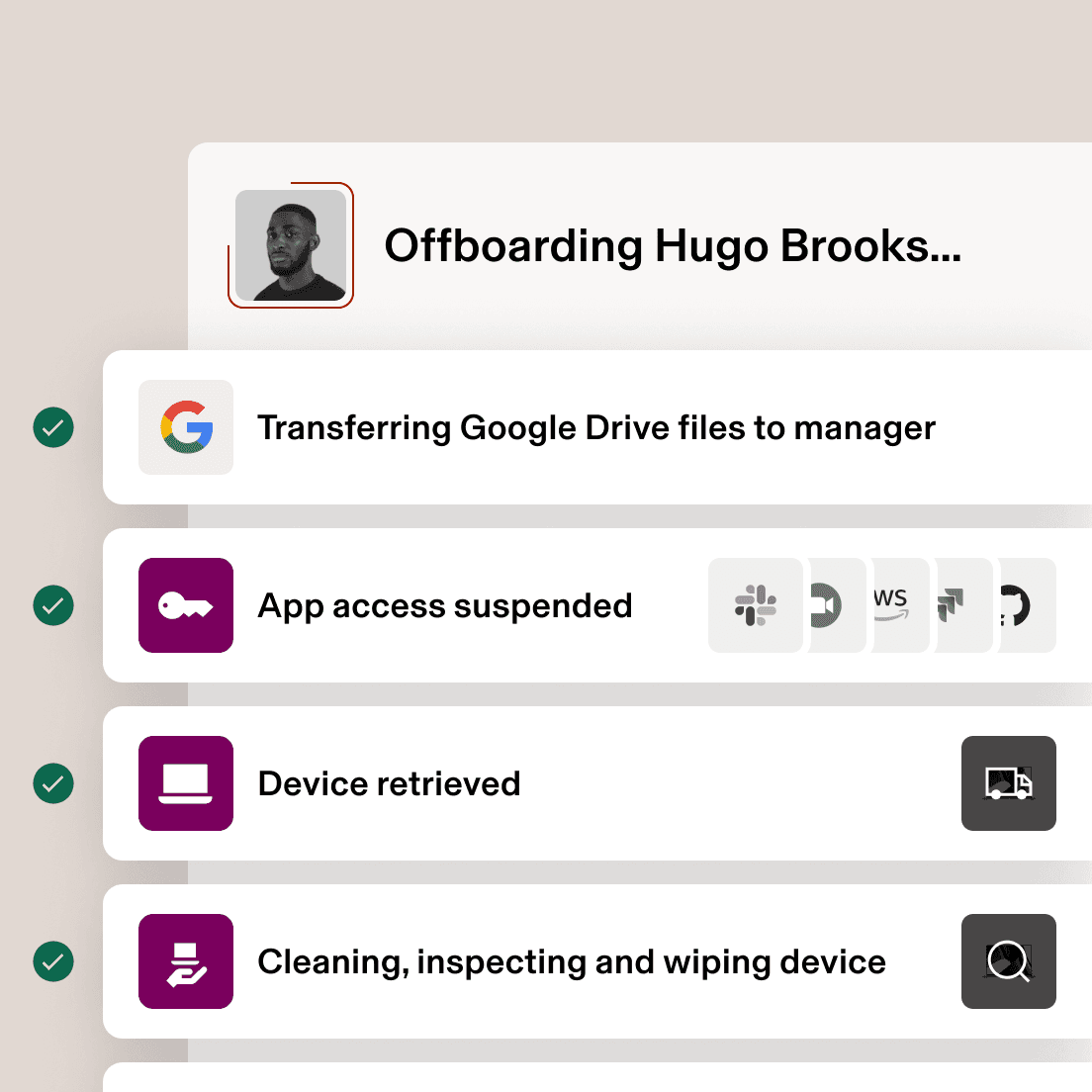
Sweden’s extended notice periods can leave businesses exposed to data security, compliance and access management risks long before an employee officially leaves. As SaaS sprawl, GDPR obligations and union oversight complicate offboarding, many organisations are discovering that outdated manual processes are no longer enough to protect sensitive systems, company IP and customer data.

26 Mar 2026
|
5 min
Inside Rippling's 10-minute onboarding
What if onboarding didn’t take days or weeks, but minutes? Here’s how Rippling sets up new hires in just 10 minutes—no IT tickets, no chasing approvals, and no delays—so employees can hit the ground running from day one and feel like they truly belong.

22 Jan 2026
|
4 min
How Athena automated license tracking for 250+ clinicians
See how Athena managed license tracking for 250+ clinicians, eliminating manual spreadsheets and ensuring compliance with automated renewal reminders.
See Rippling in action
Increase savings, automate busy work, and make better decisions by managing HR, IT, and Finance in one place.