Rippling and its affiliates do not provide tax, accounting, or legal advice. This material has been prepared for informational purposes only, and is not intended to provide or be relied on for tax, accounting, or legal advice. You should consult your own tax, accounting, and legal advisors before engaging in any related activities or transactions.
Founder spotlight: FurtherAI's CEO on door-knocking his way to product-market fit

In this article
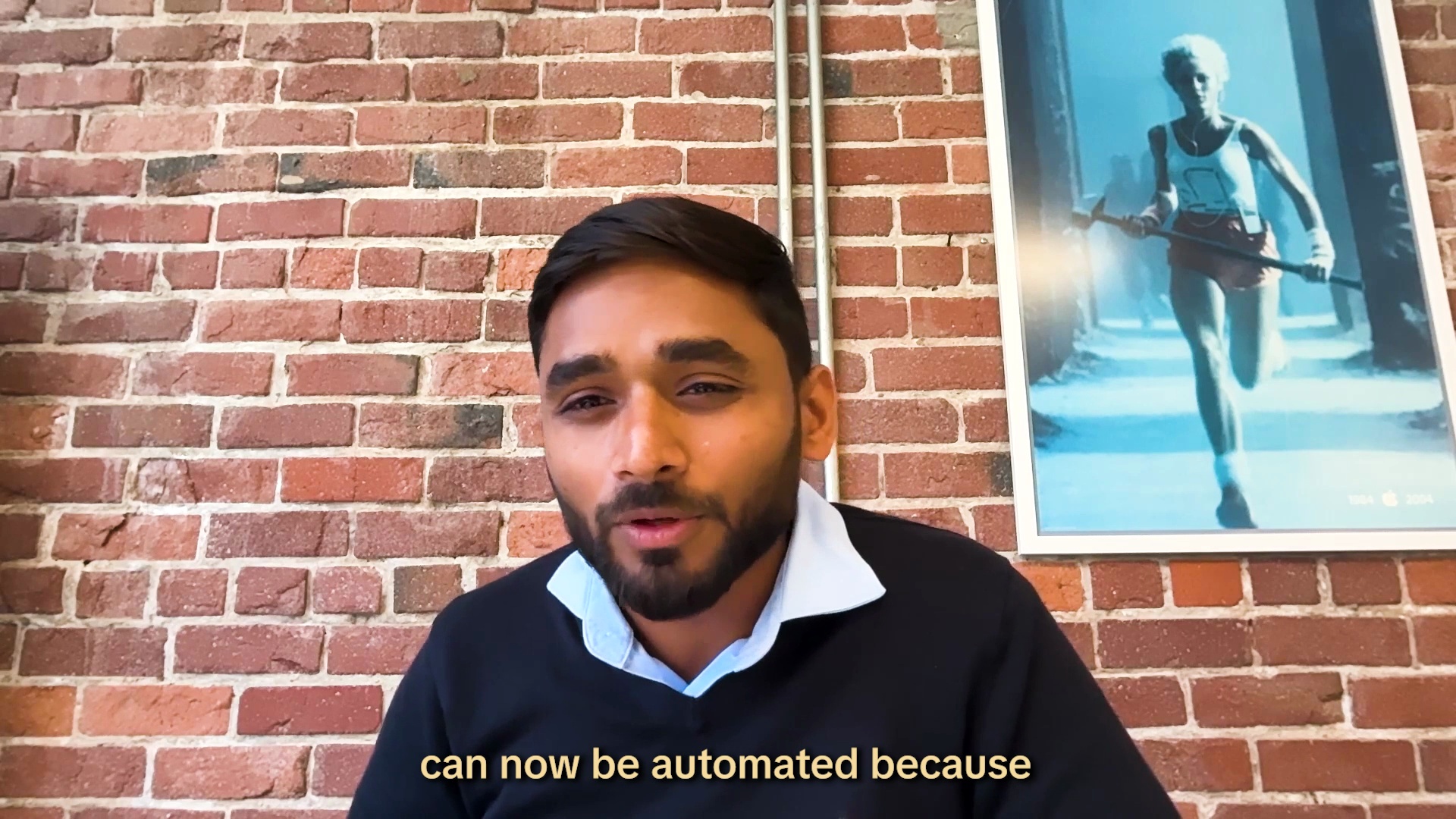
Aman Gour drove around the Bay Area with a box of donuts, knocking on the doors of insurance agencies.
He had no background in insurance, and had no warm leads. But he did have a hypothesis that AI could automate the busy work plaguing the industry, and he had a willingness to ask strangers if he was right.
Two years later, Further AI is one of the leading AI companies in insurance. They've automated workflows for underwriters, claims adjusters, and account managers at companies across the industry. Customers who signed year-long contracts have renewed. And Aman still does 70 customer conversations a week.
But before any of that, though, there were donuts and cold calls.
How FurtherAI is changing the insurance industry
Aman is a second-time founder. His first company built AI for recruiting, helping enterprises like Bank of America search massive resume databases to find the right candidates. That was back in 2018, before retrieval-augmented generation (RAG) was even a term. He and his team built their systems the hard way.
When he started Further AI, it was with an idea of AI for software testing. But after pivoting away from that, they narrowed their search to three industries drowning in unstructured data: mortgage, legal, and insurance.
Insurance stuck. Not because Aman knew the industry (he didn't), but because the people were kind. They walked him through their workflows. They gave him time. They showed him the problems that kept them up at night.
Before, a broker would send a submission to an underwriter over email. Then the underwriter would spend weeks extracting data from attachments, pulling information from the web, and assessing risk manually. Now, Further AI does it in real time, surfacing the context needed to generate quotes and close deals faster.
For an industry that touches every corner of the economy, automation like this is long overdue, and Aman's bet on "unsexy" industries is paying off.
Teams on FurtherAI are doubling productivity, improving submission-to-quote ratios by 15%, reaching over 95% accuracy in policy comparisons, and generating proposals 10x faster.
What elbow grease actually looks like when building for customers
Most founders say they're customer-obsessed. Aman proved it by showing up uninvited with pastries.
Here's how he turned cold outreach and relentless curiosity into a repeatable playbook for hard industries.
Tip 1: Do 70 customer conversations a week (and actually be present)
Aman doesn't treat sales calls like a transaction. He treats them like a conversation, meaning he's present in every single one.
"A lot of people have a lot of things to share if you're listening, " he says. His approach is simple: Do what you say you'll do, always. Be nice to work with. Enjoy the process.
It sounds obvious, but it's harder than it looks. If you promise a proof of concept, deliver it. If you say you'll follow up, follow up. When AI is automating more of the work, the human relationship becomes the differentiator.
Tip 2: Door-knock your way to insights (literally)
In the early days, Aman and his co-founder had no customers, no domain expertise, and no network in insurance. So they took a box of donuts and drove around the Bay Area, knocking on insurance agency doors.
They asked agents and brokers what AI could do for them. Where was the busy work? What ate up their time? What kept them from closing deals faster?
People were more receptive than expected. They opened up about their workflows, their pain points, and where they saw opportunity. It took six months — and a few flights to Ohio, where major insurance companies are based — but that grinding customer discovery paid off. Further AI landed their first paying customer before they even had a database.
Tip 3: Talk to end users early (learn from past mistakes)
Aman's first company took 18 months to two years to get their first paying customer. They built an entire product first, then went to market.
This time, he flipped the script. Further AI got their first paying customers without a database. They validated the demand before writing the code. “That's a very YC approach to building,” he says. “You want to become a solution in search of a problem rather than actually a solution to a problem.”
What's next for Further AI
Further AI is hiring, and Aman's learned that finding great engineers in the Bay Area is always hard. But the bigger challenge? Getting AI models to production-grade accuracy while blending in human judgment.
Shiny demos on Twitter look easy. Getting them to work reliably in high-stakes workflows — where hallucinations, confidence levels, and orchestration all matter — is where most AI projects fail. Recent data shows that 95% of AI projects don't succeed. Aman believes Further AI is in the 5% that do, because customers stick around and renew after year-long contracts.
As a second-time founder, Aman also learned to set up the right systems early to facilitate growth. He set up Rippling when Further AI was just two co-founders. Payroll, PEO, insurance — all handled from day one. "I don't think I could run this business without Rippling," he says. "Our business runs on it."
For founders eyeing hard industries — logistics, legal, insurance — Aman's advice is simple: Unsexy is the new sexy. These industries have existed for 50 years for a reason. The business models are solid. They just need someone curious enough to roll up their sleeves and build.
And maybe bring donuts.
Fast, error-free payroll
Pay yourself and your team in minutes
No sales, no friction. Execute your first payroll completely self-serve.
Disclaimer

Author
The Rippling Team
Global HR, IT, and Finance know-how directly from the Rippling team.
Explore more
Aug 21, 2025
|
5 min
Founder spotlight: Nowadays' Anna Sun on turning event planning headaches into AI innovation
Event planning can be time-consuming and manual. Nowadays CEO Anna Sun shares how automation can help startups like hers scale their events.
Aug 21, 2025
|
4 min
Founder spotlight: How CTGT’s Cyril Gorlla is making AI trustworthy for enterprise
The co-founder of CTGT talks about AI risk management and applying theoretical research to real-world use cases.
Aug 21, 2025
|
4 min
Founder spotlight: Vera Health’s co-founders on launching early and failing often
Taieb Bennani and Maxime Allouch discuss their journey from classmates to co-founders, how to grow a startup, and what’s next for Vera Health.

Oct 22, 2025
|
5 min
Founder spotlight: How PaxAI’s CEO tweaked work trials to snag top talent
Penny Chen of Pax AI redefines hiring: no whiteboard tests, just real work. Her team ships fast, hires smart, and scales lean.
Aug 21, 2025
|
4 min
How Henry AI hit $1M ARR in 8 months — with zero marketing spend
YC founder Sammy Greenwall built Henry AI to $1M ARR in 8 months—without a sales team or ad budget. Here's how founder-led growth and AI made it possible.

Nov 26, 2025
|
7 min
996 vs. 4-Day Work Week: What founders actually chose
Live debate: 996 vs. 4-day work week. Founders share what really drives performance—grind or balance—and how to avoid burnout while scaling.
Aug 21, 2025
|
2 min
The transformative power of founder leadership
Learn how Rippling fosters founder leadership with our announcement.

Mar 25, 2026
|
3 min
Facing sanctions for obstructing court orders, Deel finally unveils a defense – its spy was paid for “living expenses” & sourcing “high-value watches”
Deel now admits paying the spy who stole Rippling’s trade secrets and receiving stolen goods from the spy.
See Rippling in action
Increase savings, automate busy work, and make better decisions by managing HR, IT, and Finance in one place.