The state of AI in HR: The 2026 report (+ free implementation guide)

Get the full guide to where AI is already delivering results across recruiting, onboarding, payroll, and performance management, backed by original survey data.
In this article
Key takeaways
91% of HR teams are using AI in some capacity, but only a third have automated more than 75% of their processes.
Fewer than half of organizations have fully connected HR systems, but fragmentation is not a top concern for most organizations.
Security is the leading concern for implementing AI in HR.
Nearly two-thirds of respondents are experiencing pressure to further implement AI into their HR workflows.
AI has fundamentally changed how HR teams operate, but whether it's actually making their jobs easier is a more complicated question.
To find out, Rippling surveyed more than 500 HR professionals across the U.S. to benchmark where AI in HR is genuinely taking hold and whether the technology is delivering on its promise of giving time back.
The data reveal a story of rapid adoption outpacing operational readiness. HR professionals are using AI tools across nearly every function, from recruiting to compliance to compensation. But the systems underneath those tools often weren't built to work together.
“A lot of HR professionals don’t realize there’s a better way. These problems feel like a part of the job, and getting HR leaders to understand that there is something else out there that can actually solve them is one of our biggest hurdles,” says Emily Herron, HR Leader at Rippling.
The result is a widening gap between what AI is capable of and what most HR teams can actually execute. This report breaks down where that gap lives, what's driving it, and what it takes to close it.
91% of HR teams are using AI, but only a third have automated more than 75% of their processes
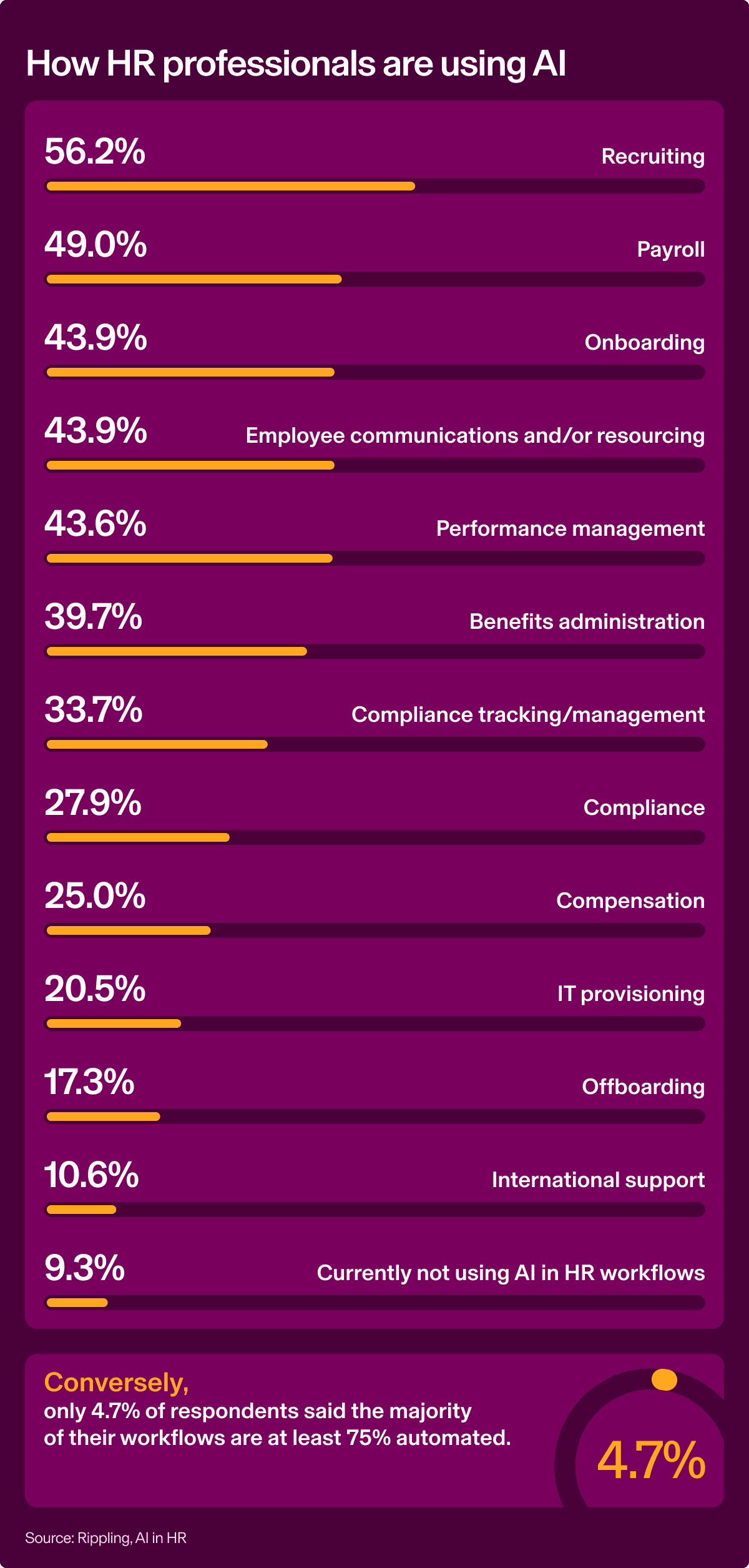
AI in HR has near-universal adoption, with 90.7% of respondents using it to support at least one HR workflow, with recruiting leading the way at 56.2%. Top use cases include:
Recruiting – 56.2%
Payroll – 49.0%
Onboarding – 43.9%
Employee communications and/or resourcing – 43.9%
Performance management – 43.6%
But adoption and execution tell two different stories. When asked what percentage of their HR processes are at least 75% to fully automated today, only 4.7% of respondents said the majority of their workflows have reached that threshold.
More than two-thirds (67.4%) estimate they've automated 50% or less of their HR processes, suggesting AI is being adopted faster than it's being operationalized.
Part of what's holding teams back is infrastructure. Only 47.1% have fully connected HR systems, while the remaining 52.9% are partially connected, manually syncing data, or operating without a formal HRIS entirely. For most organizations, AI runs on a fragmented foundation.
72% say AI is saving them time, but nearly 4 in 5 still experienced at least one payroll error last year
Nearly three-quarters of respondents (72.4%) say AI has saved their team measurable time in the past 12 months, with 39.1% saving between three and five hours per week. For HR teams stretched thin across competing priorities, that's a meaningful return.
But time savings at the top of the process don't always translate to fewer errors downstream. Nearly 4 in 5 respondents (79%) processed at least one payroll error or correction in the past 12 months, despite the majority using AI in payroll.
When HR data lives across disconnected systems, AI can accelerate individual tasks without addressing the gaps where mistakes happen.
Accuracy concerns are also shaping how HR leaders think about expanding AI use. Among those with reservations about using AI specifically in hiring decisions, 35.7% cited accuracy as their biggest concern, making it the top worry over bias, legal risk, and candidate experience.
28% cite security as the biggest obstacle to expanding AI
Security is the most cited barrier to expanding AI in HR, with more than 1 in 4 respondents (27.7%) identifying it as their biggest obstacle. It's a concern that makes sense given how much sensitive employee data flows through HR systems, from compensation records to benefits enrollment to personal identification.
For organizations looking to expand AI responsibly, the security conversation may need to start with the underlying systems. Rippling AI is built on a unified data model, so employee data doesn't need to move between platforms to power workflows, reducing the surface area for exposure.

More than 3/4 expect AI to significantly change how their team operates within 12 months
Optimism about AI in HR is high. More than three-quarters of respondents (75.4%) say they're already seeing, or expect to see soon, AI significantly change how their team operates within the next 12 months. That forward-looking confidence reflects how quickly AI has moved from a future consideration to an operational reality for most HR teams.
The pressure to move faster is real, too. Nearly two-thirds of respondents (62.2%) say they're experiencing at least some pressure from leadership to adopt AI in HR workflows, with 15.8% describing that pressure as significant.
Using Rippling [and Rippling AI] positions you better with your exec counterparts. You can show up to meetings with your finance person who's not wondering if your data's accurate — you know it's accurate. It legitimizes your seat at the table
Emily Herron
HR Evangelist at Rippling
The tension between those two findings can have a real operational impact. When the underlying systems aren't connected, accelerating AI adoption can mean layering new capabilities onto the same fragmented infrastructure, which doesn't close the gap between where HR teams are and where leadership expects them to be.

Missing concerns around fragmentation, despite many teams citing that they use at least 2-3 different systems
Despite widespread evidence of disconnected infrastructure, fragmented systems barely register as a concern. Only 8.2% of respondents identified it as their biggest barrier to expanding AI in HR, ranking it below security, data quality, cost, and lack of expertise.
Yet the operational data tells a different story. Nearly two-thirds of respondents (64.2%) say their team touches two to three separate systems to complete a single onboarding, and more than half lack a fully connected payroll and HRIS setup. The errors and delays appearing elsewhere in this data must originate somewhere.
The gap suggests most HR leaders are experiencing the symptoms of fragmentation without identifying it as the root cause. Security concerns, data quality issues, and manual correction work are often downstream effects of systems that weren't built to communicate with one another.
Unify fragmented systems with Rippling AI
The data shows that AI adoption is accelerating, but the infrastructure supporting it hasn't kept pace. Time savings are real, yet payroll errors persist. Security concerns are top of mind, yet fragmented systems, the most common source of data exposure, barely register as a named problem.
Rippling brings HR, IT, and finance onto a single platform, so employee data doesn't need to move between systems to power workflows. When a new hire is added, payroll, device provisioning, and benefits enrollment update automatically, without manual syncing or duplicate entry.
For HR teams being asked to do more with AI, the foundation matters as much as the technology. Infrastructure that connects systems is what lets every tool actually deliver.
Methodology
The survey was conducted by Centiment on July 21–July 24, 2026. It polled 537 HR leaders and HR administrators at US-based companies with 50–1,000 employees. Data is unweighted, and the margin of error is approximately ±3% for the overall sample at a 95% confidence level.
Frequently asked questions
How is AI used in HR?
AI has many use cases for HR. This includes tasks in hiring, like writing job descriptions to screening candidates, all the way to helping make compensation decisions and more. Rippling AI helps businesses reduce manual tasks so they can focus on important decisions.
What are the risks of AI in HR?
The most commonly cited risks include security, data accuracy, and lack of internal expertise, concerns shared by a significant portion of the HR professionals surveyed.
Many of these risks are amplified when AI is layered onto disconnected systems, where data inconsistencies and manual handoffs create additional opportunities for error. Addressing the infrastructure underneath AI adoption is often as important as the technology itself.
Can I integrate AI tools with Rippling?
Yes, you can integrate AI tools with Rippling. Rippling supports over 650 native integrations, many of which leverage AI to support human resources, finance, business operations, and other functions.
What AI tools can be integrated with Rippling’s platform?
AI-powered tools that integrate natively with Rippling include Algolia, Asana, Datadog, Sisense, Freshdesk, Fullstory, and many more across multiple HR modules. Native integrations mean your apps receive comprehensive, up-to-date information when providing you with analytics and recommendations.
Is AI going to replace HR?
No, AI will not replace HR or HR professionals. As much as machines may surpass humans in certain areas, they struggle with skills essential to the HR function, such as emotional intelligence, critical thinking, and strategic planning. Rather than replace HR leaders, AI will likely continue to play a supporting role, taking over repetitive tasks that distract from strategic planning and problem-solving.
How does AI help HR teams in decision-making?
AI can assist with HR decision-making in numerous ways:
Parsing resumes during recruitment and predicting job performance based on historical data.
Reviewing and aggregating performance data to identify trends and provide personalized feedback and recommendations.
Analyzing turnover, hiring, and business growth to enable better resource allocation and workforce planning.
Disclaimer
Rippling and its affiliates do not provide tax, accounting, or legal advice. This material has been prepared for informational purposes only, and is not intended to provide or be relied on for tax, accounting, or legal advice. You should consult your own tax, accounting, and legal advisors before engaging in any related activities or transactions.

Author

Vanessa Kahkesh
Content Marketing Manager, HR
Vanessa Kahkesh is a content marketer for HR passionate about shaping conversations at the intersection of people, strategy, and workplace culture. At Rippling, she leads the creation of HR-focused content. Vanessa honed her marketing, storytelling, and growth skills through roles in product marketing, community-building, and startup ventures. She worked on the product marketing team at Replit and was the founder of STUDENTpreneurs, a global community platform for student founders. Her multidisciplinary experience — combining narrative, brand, and operations — gives her a unique lens into HR content: she effectively bridges the technical side of HR with the human stories behind them.
Hubs
Explore more

Two-Thirds of European HR Teams Are Using AI — Are They Doing It Responsibly?
67% of European HR departments now use AI daily — but adoption and governance aren't keeping pace. Only 36% of HR leaders say they could confidently defend their AI decisions to a regulator. This post breaks down where the confidence gap is coming from, what's slowing teams down, and what responsible AI use in HR actually looks like in practice.

HR Is No Longer Support. It's Strategy. Are UK SMEs Ready?
HR earned its seat at the leadership table during Covid — and it's not going back to filing contracts and booking Christmas parties. With 92% of HR leaders expecting deeper AI integration but only 21% closely involved in AI strategy, UK SMEs face a clear choice: keep HR in the back office, or put it where it belongs.

Why the Best SMEs Are Building an AI-Powered Back Office
The fear around AI and jobs is understandable — but the data says otherwise. 82% of small businesses using AI grew their headcount last year, and 67% of HR teams across Europe have already reached intermediate or advanced AI adoption. The real story isn't replacement; it's capacity. Here's what the best SMEs are doing to reclaim time lost to admin, reduce operating costs, and build people operations that actually scale.

Inside the Making of Rippling AI
As AI adoption accelerates across HR, organisations face growing pressure to balance efficiency with privacy, compliance and accountability. This behind-the-scenes look at Rippling AI explores how it was built to operate within strict governance frameworks, leverage real-time workforce data and deliver trusted insights for HR, payroll and compliance teams—without compromising security or human oversight.

How the German KI-MIG Law Redefines HR and Finance Data Integrity
Germany's KI-MIG Act is bringing the EU AI Act's high-risk AI rules into sharp enforcement focus — and most HR and finance teams aren't ready. From shadow AI and audit failures to what deterministic governance actually looks like in practice, here's what the new law means for your workforce data.

The best 9 AI tools for HR automation in 2025
Revolutionize your work with top AI tools for HR automation like Rippling, Gusto, and Docebo.
Inside Rippling's HR Team: How We Use Our Own AI
Most AI tools promise transformation but deliver little more than polished chatbots. Here's how Rippling's HR team actually uses AI day to day—from handling payroll and policy questions to automating onboarding, generating reports and reducing admin work across HR, IT and finance.

The German Leader's Guide to AI-Ready HR & Finance
German CFOs and HR leaders face a double bind: strict DSGVO and GoBD rules today, and new EU AI Act obligations arriving in 2027. This guide breaks down the three pillars of compliant AI governance: human review, data privacy by architecture, and deterministic rule enforcement, plus real-world use cases for expenses, reporting, and multi-country payroll.
See Rippling in action
Increase savings, automate busy work, and make better decisions by managing HR, IT, and Finance in one place.